Quick answer
Two floors that look identical can be priced very differently because of what you cannot see: the wear layer (measured in mils for vinyl), the AC rating for laminate, the core quality, and whether it is first-quality or a second. To compare fairly, match those specs, not just the picture and the price per square foot. A thicker wear layer and a first-quality run are what make a floor last.
We see it at The BOSS all the time. Someone comes in with a price from another store and says, "Can you beat this?" And a lot of the time, the honest answer is: that depends on whether we're even looking at the same floor. Two planks can be the exact same color, the same wood look, sitting right next to each other, and carry very different price tags for reasons you can't see from across the room. Price shopping is smart. Everyone should do it. But it only works when the comparison is fair. So let's pull back the curtain on what actually moves the price on a box of flooring, so the next time you're comparing, you're comparing the real thing.
Here's the trap in one sentence: the number on the sticker only means something once you know what you're getting for it. A cheaper floor that wears out in five years isn't cheaper. It just costs you later instead of now. Let's break down where the real differences hide.
Laminate: it's the thickness and the wear layer, not just the look
Say you find an 8mm laminate at one store and a 12mm at another, same color, same style. The 12mm costs more, and it should. That extra thickness gives you a more solid, quieter floor underfoot, and usually a tougher wear layer on top, which is the clear coat that takes all the abuse from your shoes, your dog's nails, and your kids' chairs.
The number to ask about here is the AC rating. It measures how much wear a laminate can take, from AC3 for a normal home up to AC5 for a busy commercial space. A thicker board with a higher AC rating is built to last longer, and that's a big part of why one costs more than another that looks just like it. So when you're comparing two laminates, don't just match the color. Ask the thickness and the AC rating, and make sure you're lining up like with like.
Vinyl: the magic number is the mil, not the millimeter
Luxury vinyl has its own version of this, and it trips people up because the units sound the same but aren't. On vinyl, the wear layer is measured in mils, and a mil is not a millimeter. It's much thinner, and it's the single biggest thing separating a floor that holds up from one that scratches through in a hurry.
A 6 mil wear layer is light-duty. A 12 or 20 mil wear layer is what you want in a busy house with pets and kids, and 20 mil and up is genuinely commercial grade. Two vinyl planks can look identical and photograph identical, and the only real difference is that one has three times the wear layer of the other. That difference is the price, and it's the difference between a floor you replace and a floor you forget about.
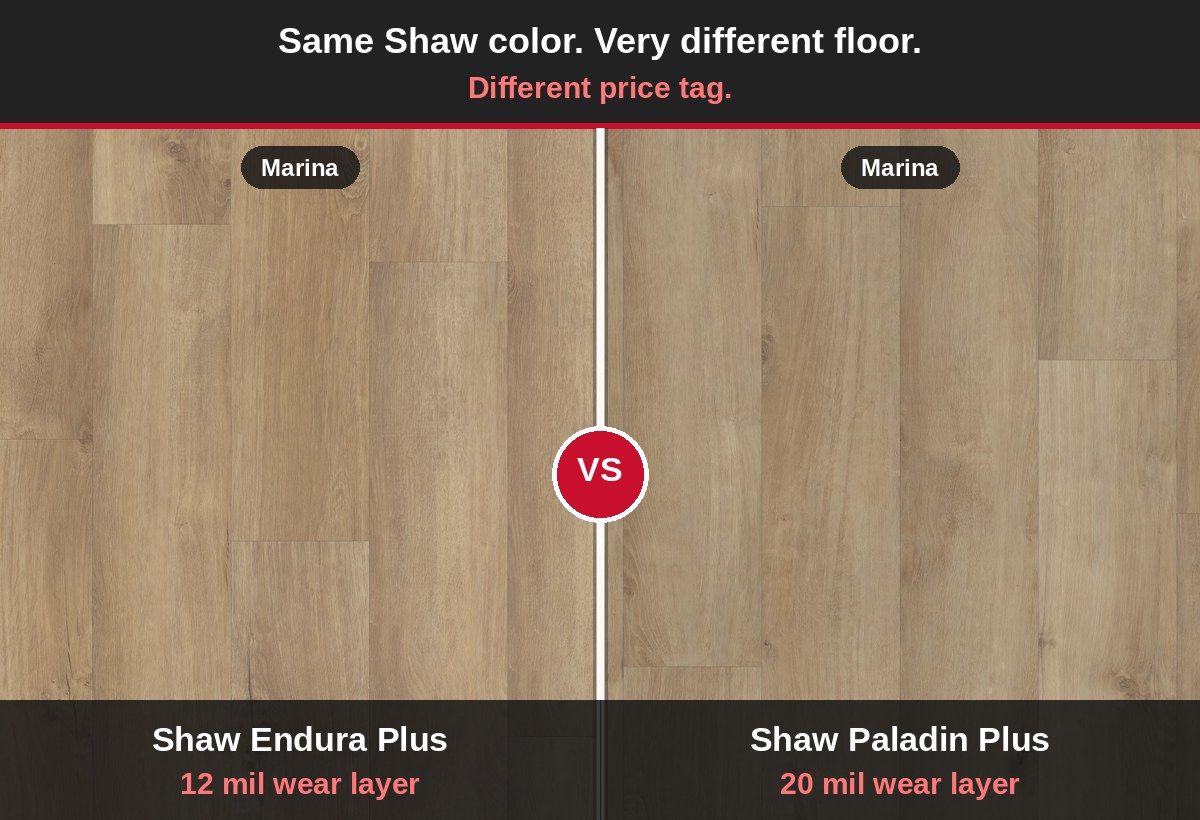
Here's a real example, and it's from a brand you know. Shaw makes a vinyl called Endura Plus with a 12 mil wear layer, and another called Paladin Plus with a 20 mil wear layer. Same manufacturer, and you can get them in the exact same colors. Set the two samples next to each other and they look like twins. But Paladin Plus has almost twice the wear layer, so it's built to take a lot more traffic, and it's priced to match. This is where good people get confused through no fault of their own. If you're pricing "that Shaw color" at two different stores, and one is quoting you Endura Plus while the other is quoting Paladin Plus, you are not comparing the same floor at all, even though the samples look identical. This happens more than you'd think, and it's exactly why the name and the color on the box aren't enough. You have to check the spec.
Then there's what's underneath. Some vinyl planks come with a cork back or an attached pad. That layer makes the floor quieter, warmer under bare feet, a little softer to stand on, and more forgiving of small imperfections in your subfloor. It's a real upgrade, and it costs a little more, so if one plank has it and the other doesn't, that's another reason the prices don't match. And the rigid core itself, whether it's SPC or WPC, changes both the feel and the cost. (If those letters are a blur, we wrote a whole plain-English guide to them: WPC, SPC, LVP and LVT decoded.)
The closeout question: a great deal with one thing to watch
Sometimes that rock-bottom price is real, and it's a closeout, meaning the product is being discontinued or it's the tail end of a run. Closeouts can be a fantastic way to save on a first-quality floor, and we love pointing customers to a good one. But there's one thing you have to go in knowing: when it's gone, it's gone.
Here's where that bites, and I've seen it happen. You buy just enough to cover your rooms, the installer comes up one box short, or you mismeasure by a little, or a plank gets damaged and needs replacing a year later. On a closeout, there may not be another box to buy. And even if you find one, flooring is made in batches called dye lots, and a box from a different run can be a shade off, just enough to notice in the daylight. On a regular running-line product you can reorder and match. On a closeout, that safety net is gone.
None of that means skip the closeout. It means buy smart. Measure carefully, add your extra for waste and future repairs up front, and grab it all at once. This is exactly the kind of thing worth thinking through before you buy, and it's one reason we always tell people to measure twice. (More on that in our questions to ask before you hire a flooring contractor.)
First quality vs. "seconds" is a whole different conversation
There's one more thing hiding behind some of those jaw-dropping prices, and it's worth saying plainly. "Seconds" are products that didn't pass the quality check at the factory. Little flaws, off colors, printing or milling issues. They get sold cheap for a reason, and there's usually no warranty behind them.
That is a completely different thing from a first-quality closeout, and it's not what we do. Everything we carry at The BOSS is first quality. So if you're staring at a price somewhere that seems too good to be true, it's fair to ask the question: is this first quality, is it a closeout, or is it a second? The answer tells you what that price really means.
A simple checklist for a fair comparison
Before you decide one floor is cheaper than another, line these up side by side:
- Thickness (millimeters for laminate, plus the core on vinyl)
- Wear layer (AC rating on laminate, mils on vinyl)
- What's underneath (attached cork or pad? SPC or WPC core?)
- The warranty (how long, and what it actually covers)
- Availability (running line you can reorder, or a closeout where you buy it all now?)
- First quality or seconds (just ask)
Match those up and you'll usually find the "expensive" floor and the "cheap" floor were never the same floor at all. And every so often, they really are the same, and you found a genuinely better deal. Either way, now you know.
The bottom line
Price shopping is exactly the right instinct, and we want you to do it. We just want you to win at it, which means comparing the real thing, not just the color. That's the whole idea behind wholesale pricing at The BOSS: first-quality flooring, priced right, from a team that will actually tell you the truth about what you're looking at.
Bring us the floor you found somewhere else. Bring us the sample, the spec, the price, all of it. We'll help you read what's really on that sticker, spec for spec, and show you the honest comparison. And if that other floor genuinely is the better buy, we'll tell you that too. Come see us at The BOSS, and let's make sure you're comparing apples to apples.
Floor it like a BOSS!
The BOSS · 10850 Harry Hines Blvd., Suite 100, Dallas, TX 75220
Frequently Asked Questions
Why do two floors that look the same have different prices?
Because the things that drive price are mostly invisible in a photo: the wear layer, the core and board thickness, the backing, the warranty, and whether it's a running line or a closeout. Two planks can share the exact same color and look identical while one is built to last far longer. A fair price comparison means matching those specs, not just the color.
What does the wear layer (mil) mean on luxury vinyl, and how many mils do I need?
The wear layer is the clear protective top layer on luxury vinyl, measured in mils (not millimeters). More mils means more durability. About 6 mil is light-duty, 12 to 20 mil suits a busy home with pets and kids, and 20 mil and up is commercial grade. Two look-alike planks can differ only in wear layer, and that difference drives both how long the floor lasts and what it costs.
What is the difference between Shaw Endura Plus and Paladin Plus?
They come in the exact same colors, such as Marina, so they look identical on the sample. The key difference is the wear layer: Endura Plus is 12 mil and Paladin Plus is 20 mil. Paladin Plus is built to take more traffic and is priced accordingly. If two stores quote you the same Shaw color but one is Endura Plus and the other is Paladin Plus, you are not comparing the same floor.
What does the AC rating mean on laminate flooring?
The AC rating measures how much wear and abrasion a laminate can take, from AC3 for a normal home up to AC5 for busy commercial spaces. Along with board thickness in millimeters, it is a big reason two laminates in the same color can carry different prices. Ask for both the thickness and the AC rating when you compare.
Are flooring closeouts a good deal?
They can be a great way to save on a first-quality floor, as long as you go in knowing that when it's gone, it's gone. If you come up a box short from a mismeasure, or need a replacement later, there may be none left, and a box from a different dye lot can be slightly off in shade. Measure carefully, add extra for waste and future repairs, and buy it all at once.
What is the difference between first-quality flooring and seconds?
Seconds are products that did not pass the factory's quality check, with flaws, off colors, or milling issues, and they are usually sold cheap with no warranty. That is different from a first-quality closeout. Everything at The BOSS is first quality. If a price elsewhere looks too good to be true, ask whether it is first quality, a closeout, or a second.
When you are ready to put our number into the comparison, here is our Dallas flooring selection.